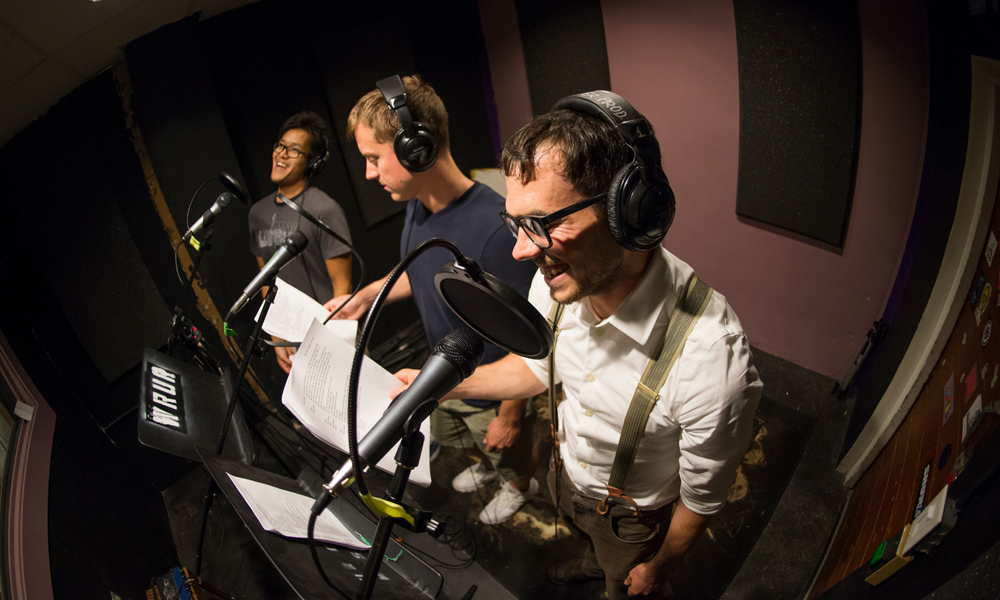
Poet Stephen Vincent Benet called radio the
“theater of the mind.” His description was
coined during the medium’s heyday in the
1930s and 1940s when a myriad of original
prose and verse plays were being produced
and aired by the networks. The foremost
radiowright of the time was Norman Corwin,
whose works soared to literary heights and
were tuned into and admired by millions.
He
was joined by many writers whose efforts were traditionally geared to the print media. These
writers saw in the audio medium a chance to
reach larger audiences with their works, and
so they generated a significant amount of original material for it. Among the most famous
print authors to ply their craft to the ethereal
page were W.H. Auden, Arthur Miller, Pearl
S. Buck, Archibald MacLeish, Irwin Shaw,
and Edna St. Vincent Millay. The medium
itself engendered other great writers besides
Corwin. A close rival was Arch Oboler, whose
popular thrillers brought chills and thrills
to the listening audience.
Perhaps the most
famous of all radio dramas was Orson Welles’s
adaptation of H.G. Wells’s War of the Worlds.
It was so brilliantly evocative in its performances, writing, and production values that it
quite literally sent its audience into a panic.
Following the arrival of television, radio
dramas all but vanished from the airwaves.
The networks were gone, and local stations could ill-afford their manufacture. Over the
decades since, attempts have been made to
revive the art form (CBS and Mutual radio
networks offered short-lived series), but the
radio drama was and continues to be of
only passing interest to an audience with a
rapidly diminishing attention span and visual
orientation. In recent years, Public radio has
become engaged in Radio Theater, and it
is there that the medium’s greatest artistic
rendering makes occasional appearances.
Fortunately, dozens of Web sites on the
Internet now preserve these valuable pieces
of radio art and Americana. A search for
“radio dramas” will result in a listing of
everything from pop favorite “The Lone
Ranger” to Corwin’s historic “On a Note of
Triumph.”
The Programmer
PDs are radiophiles. They live the medium.
Most admit to having been smitten by radio
at an early age. “It’s something that is in your
blood and grows to consuming proportions,”
admits programmer Peter Falconi. Longtime
PD Brian Mitchell recalls an interest in the
medium as a small child and for good reason.
“I was born into a broadcasting family. My
father is a station owner and builder. During
my childhood, radio was the primary topic
at the dinner table. It fed the flame that I
believe was already ignited anyway. Radio
fascinated me from the start.”
The customary route to the programmer’s job involves deejaying and participation in other on-air-related areas, such as
copywriting, production, music, and news.
It would be difficult to state exactly how
long it takes to become a PD. It largely
depends on the individual and where he
or she happens to be. In some instances,
newcomers have gone into programming
within their first year in the business.
When
this happens, it is most likely to occur in a
small market where turnover may be high.
On the other hand, it is far more common
to spend years working toward this goal,
even in the best of situations. “Although my
father owned the station, I spent a long time
in a series of jobs before my appointment
to programmer. Along the way, I worked as station janitor, and then got into announcing, production, and eventually programming,” recounts Mitchell.
One of the nation’s foremost air personalities and hall of famer, Dick Fatherly,
whom Billboard Magazine has described as
a “longtime legend,” spent years as a deejay
before making the transition. “In the 25
years that I’ve been in this business, I have
worked as a jock, newsman, production
director, and even sales rep. Eventually I
ended up in program management. During
my career I have worked at WABC, WICC,
WFUN, WHB, to mention a few. Plenty
of experience, you might say,” comments
Fatherly.
Experience contributes most toward the
making of the station’s programmer. However,
individuals entering the field with hopes of
becoming a PD do well to acquire as much
formal training as possible. The programmer’s
job has become an increasingly demanding
one as a result of expanding competition.
“A good knowledge of research methodology,
analysis, and application is crucial. Programming is both an art and a science today,”
observes general manager Jim Murphy. Programmer Andy Bloom concurs with Murphy,
adding, “A would-be PD needs to school himor herself in marketing research particularly.
Little is done anymore that is not based on
careful analysis.
Publisher B. Eric Rhoads echoes this
stance. “The role has changed. The PD used
to be a glorified music director with some
background in talent development. Today
the PD must be a marketing expert. Radio
marketing has become very complex, what
with telemarketing, database marketing,direct mail, interactive communication (fax,
computer bulletin boards), and so forth.
Radio is changing, and the PD must adapt.
No longer will records and deejays make
the big difference. Stations are at parity in
music, so better ways must be found to set
stations apart.”
Says Shane, “The ultimate analogy for the
PD is ‘brand manager,’ overseeing not only
the product, but also the image and perception of the product. Since programmers
now must work hand in hand with sellers
to maximize station revenues, there’s a new
awareness of the marketing dimension.”
Cognizant of this change, schools with
programs in radio broadcasting have begun
to emphasize courses in audience and
marketing research, as well as other
programming-related areas. An important
fact for the aspiring PD to keep in mind
is that more people entering broadcasting
today have college backgrounds than ever
before. Even though a college degree is not
necessarily a prerequisite for the position
of PD, it is clearly regarded as an asset by
upper management. “It used to be that a
college degree didn’t mean so much. A PD
came up through the ranks of programming,
proved his ability, and was hired. Not that
that doesn’t still happen. It does. But more
and more the new PD has a degree or, at
the very least, several years of college,” contends Joe Cortese, syndicated air personality. “I majored in Communication Arts at
a junior college and then transferred to a
four-year school. There are many colleges
offering communications courses here in
the Boston area, so I’ll probably take some
more as a way of further preparing for the
day when I’ll be programming or managing
a station. That’s what I eventually want to
do,” says Cortese, adding that experience in
the trenches is also vital to success.

His point is well taken. Work experience does head the list on which a station
manager bases his or her selection for PD.
Meanwhile, college training, at the very
least, has become a criterion to the extent
that if an applicant does not have any, the
prospective employer takes notice.
Beyond formal training and experience, Chuck Ducoty, major-market station
manager, says a PD must possess certain
innate qualities. “Common sense and a good
sense of humor are necessary attributes and
are in rather short supply, I think.” Dick
Fatherly adds sensitivity, patience, compassion, and drive to the list.