Our entire world — in fact, the
human being himself—is a combination
of approximately ninety-two substances,
called elements. I n spite of this large
number of elements, each in turn is
composed of two basic units, the positive
proton and the negative electron. The
difference between iron and copper, for
example, lies not in the basic units of
which they are composed, but rather in
the quantity and the position of these
units.
Electrons and protons in combination
are known as atoms. The proton (one
or more) represents the central or nuclear positive charge, while the electron
(or electrons) represents the outer or
negative charge. These electrons revolve
around the central unit in an elliptical
path or orbit in much the same manner
as the planets in our solar system revolve about the sun. The atoms which
make up the various elements differ
mainly in the fact that some have several rings of electrons, rather than a
single ring.
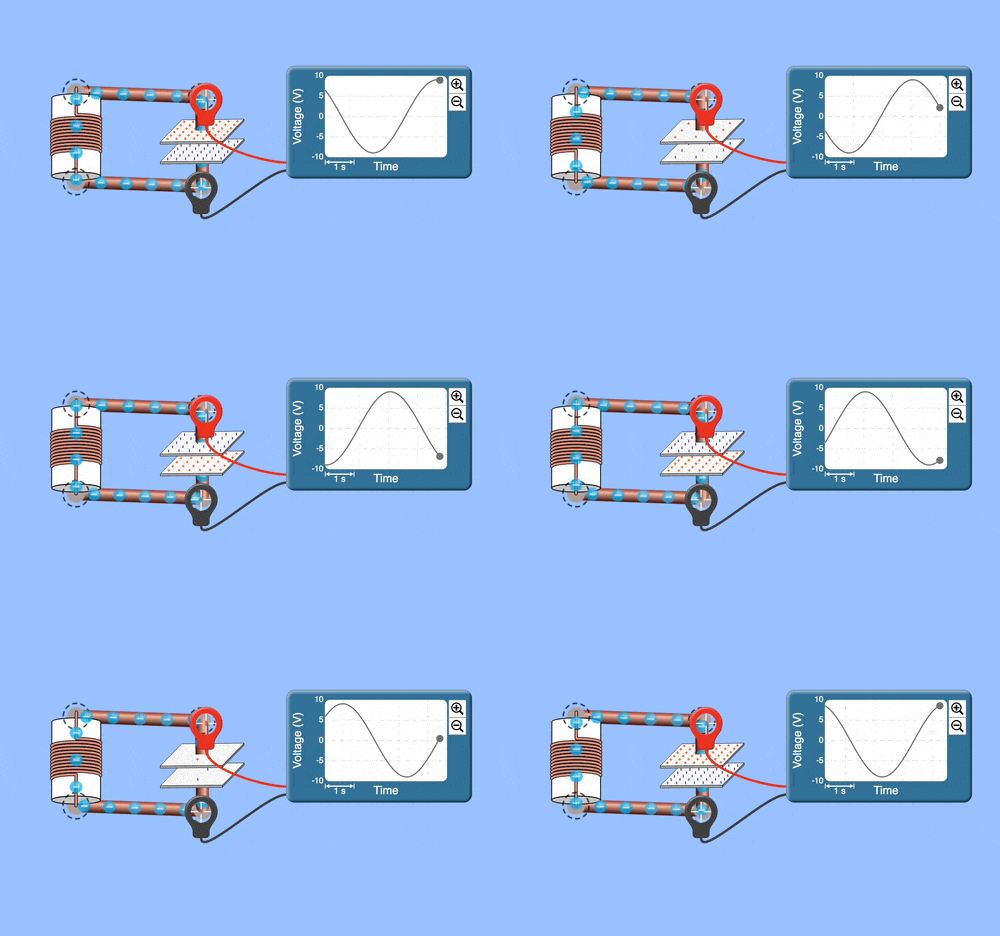
The electrons in the orbits which
surround the positive nucleus have a
charge that is exactly equal to the central unit, and, since they are opposite in
polarity, a perfect state of balance exists. It is this same general state of
balance which exists throughout nature,
generally speaking.
It is important to understand that an
atom (or atoms) containing several orbits of electrons around the central portion (nucleus) will have many of its
electrons at a considerable distance from
the nucleus, and consequently these electrons will not be so strongly held as those
in the nearer orbits.
I n relative size the proton is considered to be approximately 1,845 times larger
than the electron. Any attempt to visualize the actual physical mass of either
is quite impossible, the realization becoming evident when it is considered that
countless billions upon billions of electrons and protons make up a tiny piece
of copper wire.
When this enormous quantity of atoms
in any particular object is taken into
consideration, it is easier to understand
why, when electrons in some far-removed orbit are not so strongly held by
their central positive proton, such electrons are very apt to be attracted by
some other atom which has previously
lost its outer electron. Thi s is exactly
what happens.
The atom at all times seeks to maintain a state of balance; this is accomplished only when an atom has the
proper number of electrons. I f one electron is lost to some other atom, balance
is quickly restored by attracting another. Consequently, there is a continuous helter-skelter movement of electrons,
a constant shifting from one atom to
another. The electrons which move about
in a substance are called free electrons,
and it is these free electrons that make
possible the electric current.
Conductors and Insulators
Should the atomic structure of a certain material be such that all of the
electrons in an individual atom are
tightly held by their positive proton and
tend to remain within their own orbits,
the material or substance will have very
few free electrons and becomes what is
known as an insulator. Mica, glass, porcelain and dry ai r are examples of such
insulators.
On the other hand, materials that have
a large number of free electrons are
known as conductors. Most metals, such
as copper, silver and aluminum, are conductors. The ability of a material to pass
an electric current is known as its conductivity. Metals which have high conductivity may be said to have low resistance to the flow of an electric current.
The Electric Current
The free electrons in a conductor move
constantly about and change their position in a haphazard manner. If, however,
the conductor is connected between the
positive and negative terminals of a battery, there will be a steady movement
of electrons from the negative to positive terminal, in addition to the irregular
movement of the electrons. Thi s flow
constitutes an electric current, but as
soon as the battery is removed, the current will cease.
It can be said in explanation that when
the battery was first connected to the
wire, there existed a shortage of electrons at one terminal which the electrons at the other terminal attempted to
supply.
Remember that the constant movement
of electrons in a definite direction creates an electric current. I n the previous
example, the constant electron movement
was brought to a halt when the battery
was disconnected since the surplus electrons immediately supplied the deficiency
existing at one end and established a
balance throughout the entire conductor.
Resistance
The molecular structure of certain
metals is such that when the free electrons are made to flow in a definite direction, there are frequent collisions between them and the individual atoms in
the material. The result of these collisions is to decrease the total electron
flow. Thi s ability of a substance to resist the steady electron flow is called its
resistance.
I t will require a greater electromotive
force to produce a given current through
a substance with high resistance than to
produce the same current in a good conductor. I n the case of the conductor
virtually all of the electromotive force
is effective in producing current, whereas in the resistor a portion is wasted in the form of lost energy due to electron
collisions. These collisions cause the material to become heated, and part of the
initially-applied electromotive force is
thus ultimately lost in the form of heat.
This same phenomenon of heat is exhibited when a metal is repeatedly struck
by a hammer.
The resistance of a uniform length of
material is directly proportional to its
length and inversely proportional to its
cross section. A wire with a certain resistance for a given length will have twice
as much resistance if the length of the
wire is doubled.
F o r a given length, doubling the size
(cross section) of the wire will halve
the resistance. It is also important to
note that the resistance of most materials will increase as the temperature is
increased. Thus, the resistance of the
filament in a vacuum tube, or in a tungsten electric lamp, is many times higher
when brought to operating temperature
than when it is cold.
The Ampere
The strength of an electric current depends upon the rate at which electrons
pass a given point. The units of measurement are the ampere and the coulomb,
one ampere being equal to 6.28 X 10"
electrons passing a given point in one
second. The generally-used term in electrical practice is the ampere, in which
the time element is already implied and
need not be stated, as would be the case
when referring to current in terms of
coulombs (coulombs per second).
The Volt
The electrons are driven through the
wires and components of a circuit by a force called an electromotive force, usually abbreviated e.m.f. or E.M.F. The
unit that denotes this force is called the
volt. This force or pressure is measured
in terms of the difference in the number
of electrons at one point with respect
to another. This is known as the potential difference.
The relationship between the electromotive force (voltage) to the flow of
current (amperes), and the resistance
which impedes the flow of current
(ohms), is very clearly expressed in a
simple but highly valuable law known
as Ohm's law.
Power Measurements and Formulas for Resistive Circuits
When a voltage causes a given current
to flow through a resistor, heat is
generated or dissipated by the resistor.
This loss is attributable to the molecular
structure of the material through which
the current is made to pass. I n other
words, i f the constant flow of electrons
is always coming into contact with the
atoms of the material through which the
electrons flow, there will be countless
collisions and the electrons must, therefore, be forced through in order that a
given number will constantly move
through the conducting medium. This
phenomenon results in heating of the
conductor, and this heating results in a
loss of power or energy.
From Ohm's law, E = I X R> it can
readily be seen that if the resistance of a
circuit is doubled, it will require twice
the voltage to maintain the same current
flow through the added resistance. This
expenditure of power can be considered
as the product of the voltage and current
in the circuit and is expressed in watts.
Hence, W (watts) = E X I.
I is the current in amperes.
Thi s equation is used in the following
typical example: The voltage drop across
a cathode resistor in a power amplifier
stage is 50 volts; the plate current flowing through the resistor is 150 milli -
amperes. The number of watts the
resistor will be required to dissipate is
found from the formula: W (watts) =
E X I , or 50 X .150 = 7.5 watts (.150
amperes is equal to 150 milliamperes).
Fro m the foregoing it is seen that a
7.5-watt resistor will safely carr y the
required current, yet a 10- or 20-watt
resistor would ordinarily be used to provide a safety factor.
Voltage Dividers
A voltage divider is exactly what its
name implies: a resistor or a series of
resistors connected across a source of
voltage from which various lesser values
of voltage may be obtained by connection
to various points along the resistor.
A voltage divider serves a most useful
purpose in a radio receiver, transmitter
or amplifier, because it offers a simple means of obtaining plate, screen and
bias voltages of different values from a
common power supply source. It may
also be used to obtain very low voltages
of the order of .01 to .001 volts with a
high degree of accuracy, even though a
means of measuring such voltages is
lacking. The procedure for making these
measurements can best be given in the
following example:
Assume that an accurately calibrated
0-150 voltmeter is available and that the
source of voltage is exactly 100 volts.
Thi s 100 volts is then impressed through
a resistance of exactly 1,000 ohms. I t
will, then, be found that the voltage along various points on the resistor, with
respect to the grounded end, will be
exactly proportional to the resistance at
that point. From Ohm's law, the current
would be 0.1 ampere; this current remains unchanged since the original value
of resistance (1,000 ohms) and the voltage source (100 volts) are unchanged.
Thus, at a 500-ohm point on the resistor
(half its entire resistance), the voltage
will likewise be halved or reduced to 50
volts.
The equation ( E = I X R ) gives the
proof: E = 500 X 0.1 = 50. At the
point of 250 ohms on the resistor, the
voltage will be one-fourth the total value
or 25 volts ( E = 250 X 0.1 = 25). Continuing with this process, a point can be
found where the resistance measures
exactly one ohm and where the voltage
equals 0.1 volt. It is^ therefore, obvious
that if the original source of voltage and
resistance can be measured, it is a
simple matter to predetermine the voltage at any point along the resistor, provided that the current remains constant.
Bleeder Resistors
Often resistors are connected across
the output terminals of power supplies
in order to bleed off a constant value
of current or to serve as a constant fixed
load. The regulation of the power supply
is thereby improved and the voltage is
maintained at a more or less constant
value, regardless of load conditions.
When the load is entirely removed from
a power supply, the voltage may rise to
such a high value as to ruin the filter
condensers.
The amount of current which can be
drawn from a power supply depends
upon the current rating of the particular power transformer in use. I f a transformer will carry a maximum safe current of 100 milliamperes, and if 75 milli -
amperes of this current is required for
operation of a radio receiver, there
remains 25 milliamperes of current
available which can be wasted in the
bleeder resistor.
A n example for calculating bleeder
resistor values for safe wattage rating
is as follows: The power supply delivers
300 volts. The power transformer can
safely supply 75 milliamperes of current,
of which 60 milliamperes will be required for the receiver. The problem is
to find the correct value of resistance to is equivalent to .015 ampere.) Therefore,
it is seen that the bleeder resistor should
have a resistance of 20,000 ohms.
Another problem would be to find the
required safe wattage rating of the
bleeder, under the same conditions as
given in the previous example. The
answer is secured as follows: W = E
X I = 300 X -015 = 4.5 watts. It is
considered good practice to allow an
overload factor of at least 100 per cent,
since the voltage will increase somewhat
when all load except the bleeder is removed. Therefore, a 10-watt resistor
should be chosen.
Voltage Divider Design
Proper design of a voltage divider for
any type of radio equipment is a relatively simple matter. The first consideration is the amount of bleeder current to
be drawn, which is dictated largely by
the examples previously given. I n addition, it is also necessary that the desired
voltage and the exact current at each
tap on the voltage divider be known.
The current does not flow from the
tap-on point through the resistor to
ground or negative terminal, but rather
from the positive side, then out through
the tap, then through the device to
ground. This explanation can be more
easily followed by referring to figure 4,
wherein the arrows indicate the direction
of current flow through the external
load.
The device which secures current from
the voltage divider is indicated as C. The
current drawn by C flows through section A of the bleeder resistor, then
through C, and back to ground. The
bleeder current, however, flows through
the entire divider, i.e., through both A
and B . Therefore, it becomes apparent
that when a tap-on point is chosen to
give the voltage desired, it is necessary
to consider not only the current drawn
by the device C, but also the bleeder
current.
